Did the Bible Predict the End of the Universe or the End of Jerusalem?
Stevie DxYz
12/16/20253 min read
Why Futurism Collapses Under Its Own Weight
🔥 Read this slowly
If cosmic-collapse language in the Bible always meant literal universal destruction,
then the universe should have ended at least six times already.
It didn’t.
So either:
The prophets were wrong
Jesus copied their mistakes
Or futurists never learned how prophetic language works
This post proves which one it is.
1. The rule futurists do not want you to know
Prophetic language has rules.
And the Bible uses the same rules over and over.
In the Ancient Near East, cosmic imagery was judgment language, not astrophysics.
When prophets spoke of:
The sun going dark
Stars falling
Heaven and earth shaking
God coming on clouds
They were announcing:
The fall of a king
The collapse of a nation
The end of an order
Not the end of the universe.
And mainstream biblical scholarship has recognized this for decades. Writers such as G. B. Caird (biblical imagery), John Walton (Ancient Near Eastern thought), and N. T. Wright (Second Temple Judaism) all emphasize that apocalyptic language commonly describes God acting within history using stock cosmic metaphor, not predictions of astronomical destruction.
This is not fringe theology.
This is Prophets 101.
2. Isaiah 13
Isaiah prophesies Babylon’s fall with cosmic language:
Sun darkened
Stars stop shining
Heavens shaken
But Isaiah is not vague about what he means. He names the target. Babylon.
Historical reality:
Babylon fell to the Persians in 539 BC
The cosmos did not collapse
Life continued
Conclusion: the language worked exactly as intended.
Symbolic judgment on an empire.
If Isaiah 13 is not literal astronomy, futurists do not get to demand literal astronomy later.
3. Isaiah 19
“The LORD rides on a swift cloud and comes to Egypt.”
Did God surf on a cloud over Egypt like a movie scene?
No.
Isaiah is announcing judgment. Real-world upheaval. The humbling of Egypt’s power and idols. God “came” through historical events.
Key point:
“Coming on the clouds” is judgment language, not a visible descent.
4. Nahum 1
Nahum describes Nineveh’s fall like creation is coming apart:
Mountains quake
Earth heaves
The world trembles
Fulfillment:
Nineveh was destroyed in 612 BC
No planetary catastrophe followed
Same language. Same function. Same outcome.
5. Ezekiel 30 and 32
Ezekiel prophesies judgment on Egypt using royal funeral language:
Sun covered
Moon darkened
Stars extinguished
Translation: when a kingdom falls, its lights go out.
Egypt’s political glory was brought low. Pharaoh was humiliated. The prophecy lands exactly where Ezekiel aimed it. On a nation.
6. Amos 8
God tells Israel:
“I will make the sun go down at noon.”
What follows in the prophets is not stargazing. It is covenant judgment:
National collapse
Defeat
Exile
No astronomer panicked. Everyone understood the message.
7. Joel 2 and Acts 2
Joel foretold:
Sun darkened
Moon to blood
Day of the LORD
Then Peter stands up in Acts 2 and says:
“This is that.”
Peter does not stop and teach a science lesson. He treats Joel’s language as prophetic fire, announcing God’s covenant action arriving in their time.
That is how these texts work.
8. Josephus
Josephus reports omens and signs in the years leading to AD 70, things people interpreted as judgment warnings, not the end of the solar system.
Crucial point:
Ancient people knew how to read signs as judgment language tied to a city, a people, a temple, an order.
9. Jesus and Matthew 24
Jesus speaks in the same prophetic idiom:
Sun darkened
Stars fall
Son of Man comes on clouds
“This generation will not pass away”
Result:
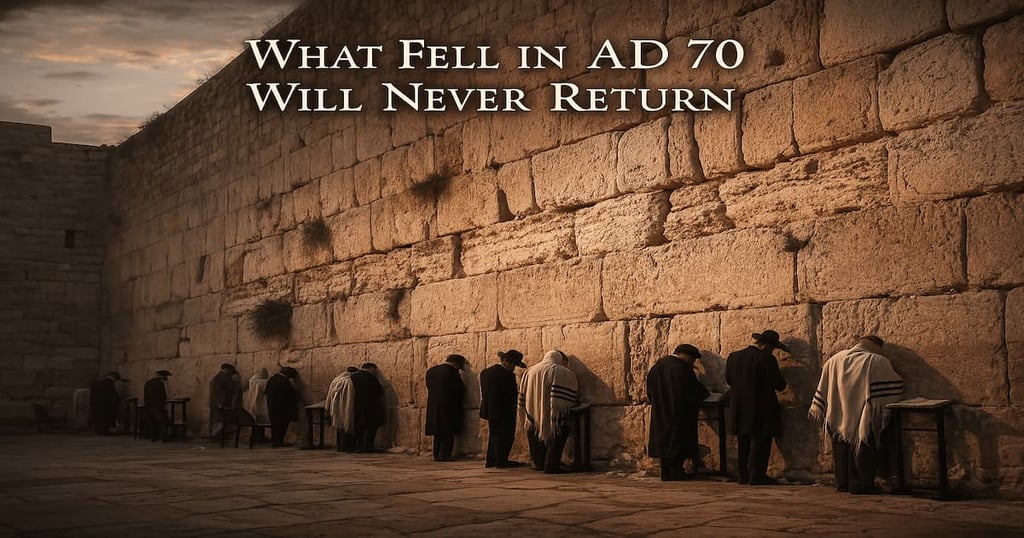
Jerusalem was destroyed in AD 70
The temple system ended
Jesus did not invent a new language. He used the prophets’ language.
And Revelation 1:7 nails the audience marker by pointing to those connected to the crucifixion, not some distant generation thousands of years later.
Final blow
Futurism survives on one move only:
Pretend prophetic language suddenly changes meaning when Jesus uses it.
But:
Isaiah did not change it
Ezekiel did not change it
Joel did not change it
Peter did not change it
So why trust interpreters born 1,900 years later to rewrite the prophets?
If Matthew 24 is literal astronomy, then the prophets were liars.
If the prophets were right, futurism is dead.
Jesus kept His word.
Jerusalem fell.
The old order ended.
The only thing still waiting to collapse is futurism itself.