
The Abomination Was Seen: A Temple Timeline from AD 70
Stevie DxYz
1/13/20263 min read
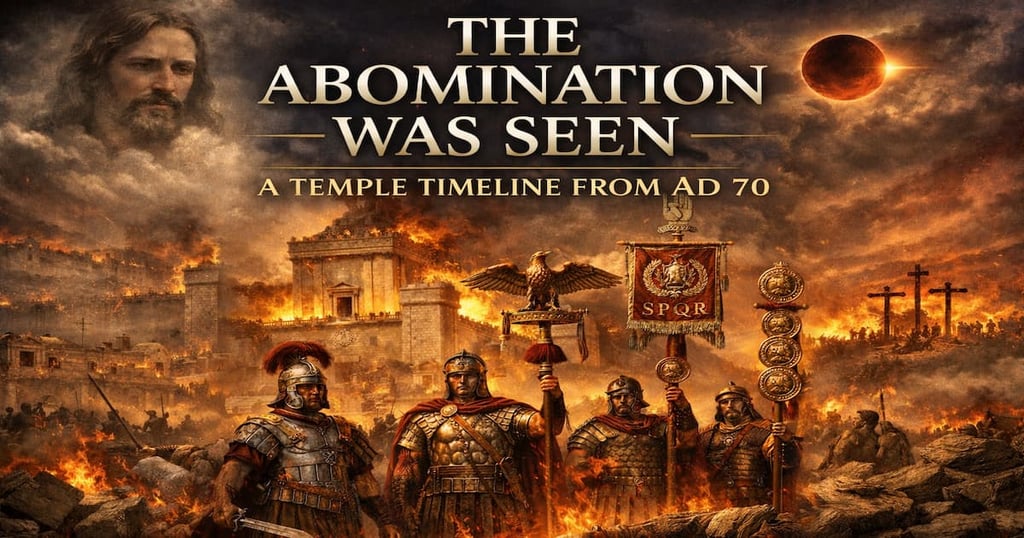
Discussions about Jesus’ warning of the “abomination of desolation” often dissolve into theology before the historical evidence is examined. This article does not attempt to settle doctrinal disputes. It asks a single historical question:
Do Jesus’ Temple-specific predictions align, claim by claim, with what happened at the Temple in AD 70?
To answer that question, this study restricts itself to near-contemporary primary sources:
Matthew 24
Mark 13
Luke 21
The Jewish War, Book 6, by Flavius Josephus
Each Gospel is treated on its own terms. No forced harmonization is imposed. Where accounts overlap, those overlaps are compared. Where they differ, the differences are left intact.
The “abomination of desolation” Jesus warned about was not an abstract symbol or distant future event. According to near-contemporary history, Roman standards were placed within the Temple precincts in AD 70 and sacrifices were offered there. This article traces a Temple-centered timeline using Matthew 24, Mark 13, Luke 21, and Josephus’ Jewish War Book 6 to evaluate that event claim by claim.
Why AD 70 Matters for Jesus’ Temple Predictions
Jesus’ warnings were not framed as abstract theology. He pointed to a visible Temple, a real city, and concrete signs His listeners could recognize. His instructions, especially the command to flee, only function if the predicted events were observable, locational, and time-bound.
If those warnings were fulfilled, that fulfillment must be visible in history rather than inferred later.
Josephus’ Near-Contemporary Account of the Temple’s Final Days (War 6)
Josephus places the final and decisive phase of the Roman–Jewish war inside the Temple complex itself. Once fighting reaches the Temple precincts, the narrative narrows and accelerates toward collapse.
The Daily Sacrifice Ceases
Josephus records a decisive cultic rupture: the daily sacrifice fails on the 17th of Panemus (Tammuz). He explains that this did not occur by decree, but because there were no longer enough men to maintain it.
Whatever follows, the Temple’s central function collapses before the sanctuary is destroyed.
Fire Reaches the Temple Structures
As resistance continues, Roman losses increase. Josephus reports that Roman forces set fire to the Temple gates and surrounding structures, and that the destruction spreads inward. Eventually, the sanctuary itself is consumed.
Josephus describes widespread killing within the Temple courts, using extreme language to convey the scale of the slaughter. Distinctions between priest and civilian dissolve amid the chaos.
Roman Standards in the Temple Precincts
In the aftermath of the sanctuary’s destruction, Josephus reports that Roman soldiers bring their standards into the Temple area, set them near the eastern gate, and offer sacrifices to them.
This is not described as incidental vandalism. It is presented as a deliberate ritual act carried out within consecrated space.
Following this, surviving priests descend and seek mercy. Josephus reports that they are executed. Survivors face death or captivity. The Temple complex is rendered ritually and functionally ended.
What Jesus Actually Predicted (Each Account Separately)
Before comparison, each Gospel must be allowed to speak for itself.
Matthew 24
Matthew records Jesus predicting:
The total destruction of the Temple (“not one stone left upon another”)
A visible abomination standing in the holy place
Immediate flight once that sign appears
A period of great distress centered in Judea
Fulfillment within the lifetime of Jesus’ contemporary generation
The emphasis is on visibility, location, and urgency.
Mark 13
Mark parallels Matthew closely but sharpens the spatial language:
The abomination is “standing where it ought not”
The warning is tied to physical location rather than explanation
Luke 21
Luke frames the warning differently:
Jerusalem surrounded by armies signals that desolation has drawn near
The outcome includes slaughter, captivity, and Gentile domination
Luke translates Temple-focused warnings into explicit siege conditions without redefining their seriousness.
What Counts as the “Abomination”
Across Matthew and Mark, the abomination has four consistent features:
It is seen
It stands in sacred space
It is defiling
It triggers immediate action
Josephus records an event that satisfies those criteria without symbolic reinterpretation:
Roman standards placed within the Temple precincts, near the eastern gate, accompanied by sacrificial acts.
This action is:
Publicly visible
Spatially located within consecrated boundaries
Cultically foreign
Profaning by definition
The description fits the warning as given, not retroactively imposed.
Prophecy and History Side by Side
When the claims are compared to Josephus’ account, the alignment is direct:
Temple destruction → Josephus records comprehensive ruin
Cultic collapse → The daily sacrifice ceases before the fire
Abomination seen → Roman standards and sacrifices in Temple precincts
Urgency justified → Those remaining face slaughter or captivity
Severe distress → Josephus describes devastation of unprecedented scale
Siege conditions → Jerusalem is surrounded, breached, and occupied
Where confidence weakens, it does so because of source limits, not because the predictions fail to align.
What This Study Does Not Claim
This article does not:
Depend on later Christian tradition
Stretch timelines into the future
Assume a rebuilt Temple
Force the Gospel accounts into artificial agreement
It restricts itself to what the texts say and what the historical record shows.
Verdict: The Abomination Was Seen
When confined to near-contemporary sources and testable claims, the conclusion is restrained but firm.
Jesus warned of a visible profanation in the Temple, tied to urgent flight and catastrophic destruction. Josephus records a visible profanation in the Temple precincts, followed by slaughter, captivity, and irreversible ruin.
The Temple fell.
The sign was visible.
The warning corresponded to events.
The abomination was seen.
Test It Yourself
Read Matthew 24, Mark 13, Luke 21, and The Jewish War Book 6 side by side.
This article does not ask for agreement: only comparison.
The sources remain.